


RC facilitators serve as proactive and personalized guides, helping researchers identify and implement computational approaches that result in the greatest impact to their projects. Rather than possessing a significant depth of expertise in computational technologies, RC facilitators build and leverage their team of expert technical staff and translate the details of computational options for individual researchers. Through this two-way relationship-building approach, dedicated RC facilitators have enabled previously unimagined and significant scholarship outcomes of scale and scope across a variety of research domains, especially within the space of campus-supported research computing centers.
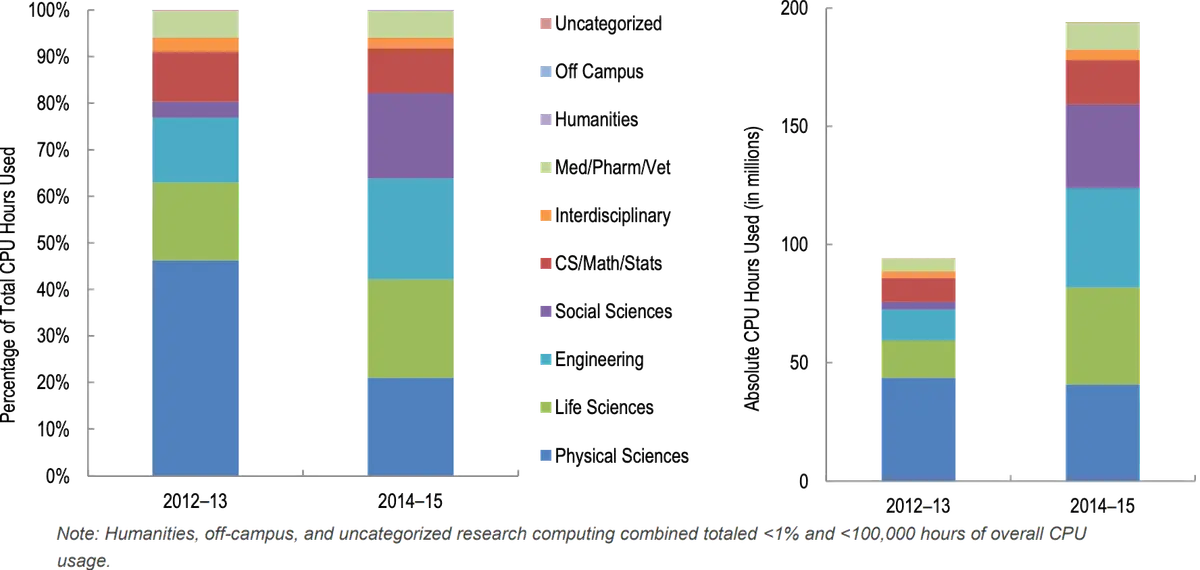
Since the hiring of the first Research Computing Facilitator in 2013 usage of computing services by previously underserved researchers increased significantly (see figure below). Importantly, more than 95% of usage from the life sciences and social sciences has been on an HTC-optimized compute configuration rather than a traditional HPC cluster, emphasizing the applicability of multiple compute configurations to meet needs across domains.
The following outlines the primary goals (the needs) of successful RC facilitation and identifies the related major activities for achieving those goals.
Three key areas of experience and interest are relevant for successful RC facilitators: individual interests and motivation, communication and interpersonal skills, and technical knowledge.
Interests and Motivation
Communication and Interpersonal Skills
Technical Abilities
More information on Research Facilitators can be found in the paper "Research Computing Facilitators: The Missing Human Link in Needs-Based Research Cyberinfrastructure" co-written by CHTC's own Lauren Michael.